Managing Anxiety During the Holidays: by a Therapist in Rancho Cucamonga
EMDR Counseling, Trauma Therapy CA , Spanish Speaking Therapist, Rancho Cucamonga Counseling, Therapist in Rancho Cucamonga
Managing Anxiety can be challenging for all use despite the idea that holidays are supposed to feel like twinkling lights, family making tamales, pozole with ponche dinners, and a well-earned break. But for some Latinos, this time of year brings something closer to dread: crowded calendars due to family obligations, financial pressure, family tension, and a nagging sense that you're supposed to be happier than you actually feel. If that sounds familiar, you're not alone — and you're not broken. As a I see this pattern every November and December, and I want to walk you through why it happens and what actually helps.
Why the Holidays Trigger Anxiety
Holiday anxiety isn't just "stress." It's often a collision of several things happening at once:
Disrupted routines. Sleep, exercise, and eating patterns shift, which throws off the nervous system's baseline.
Financial strain. Gift-giving, travel, and hosting costs add real pressure, especially with rising costs of living here in Southern California.
Family dynamics. Old roles resurface fast. You might walk in as a confident adult and walk out feeling like a teenager again. In Latino families if often see Familismo show up stronger in the holiday season. To learn more about familismo and therapy click here.
Grief and loss. An empty chair at the table can make the holidays one of the hardest times of year, not the easiest.
Social overload. For anyone managing social anxiety, back-to-back gatherings can be genuinely depleting. To learn more about social anxiety click here.
For Latinas carrying unresolved trauma, the holidays can hit even harder. Family gatherings sometimes mean sitting across from the very people or memories connected to painful experiences. This is where anxiety and trauma responses often overlap and why generic "just relax" advice tends to fall flat.
Practical Strategies for Holiday Anxiety
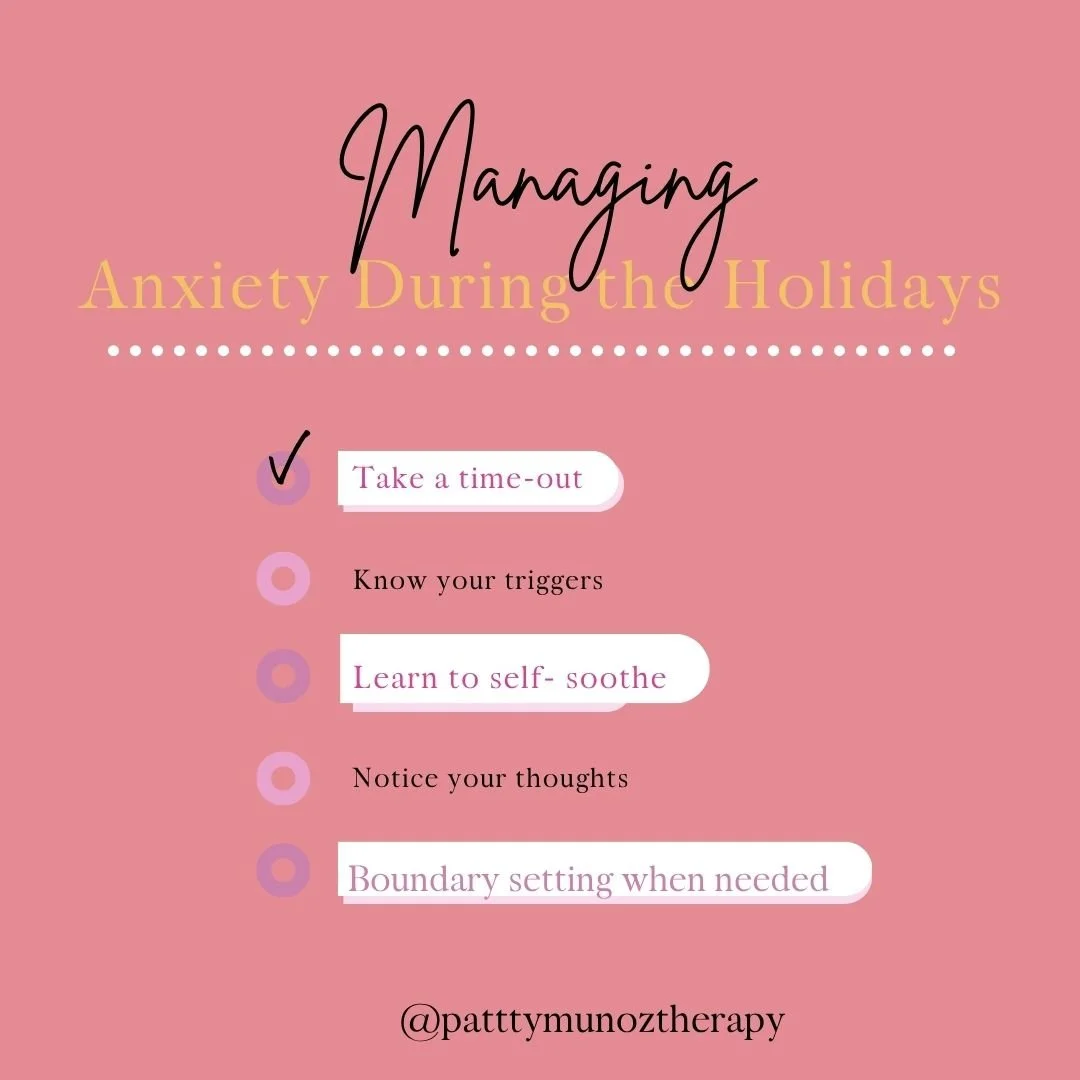
1. Take a Time Out
It's okay to physically step away. A short walk outside, a few minutes in your car, or even a quiet moment in another room can be enough to reset before you re-engage. Removing yourself from a stressful situation isn't avoidance it's a legitimate coping skill for adults.
2. Know Your Triggers From Past Holidays
Think back on previous years. Was there a specific comment, relative, or moment that set off your anxiety? Naming your triggers ahead of time takes away some of their power, because you're no longer caught off guard you can prepare for them instead of just reacting to them.
3. Learn to Self-Soothe with Grounding Techniques
Simple, portable tools — like naming five things you can see, or slow diaphragmatic breathing — can interrupt a spiral of anxiety before it builds. These are especially useful during family gatherings when you can't easily step away. Read more about finding your coping skills for anxiety here. Another important part of self-soothing is self-care and focusing on the basics of sleep and movement is essential for managing anxiety.
Protect Your Sleep and Movement
Even 20 minutes of walking or a consistent bedtime can regulate your nervous system more than people expect. Anxiety thrives on a depleted body.
4. Notice Your Thoughts When You're Anxious
Anxiety often comes with a running commentary — "this is going to be a disaster," "everyone is judging me," "I can't handle this." Simply noticing these thoughts as thoughts, rather than facts, can create enough distance to keep them from spiraling. You don't have to argue with them; just observing them is often enough to loosen their grip. Therapy can help you identify these anxiety fueled thoughts and learn to manage them. Visit our Anxiety Specialty page to learn more about how we can help with Anxiety Therapy.
5. Set Boundaries Before You Need Them
Decide in advance how long you'll stay at an event, what topics you won't discuss, and how you'll respond if things get tense. Having a plan reduces the anxiety of having to improvise under pressure. To learn more about setting boundaries in latino families read this blog.
Give Yourself Permission to Say No
You don't have to attend every event or say yes to every request. A full calendar isn't the same as a meaningful one.
Notice When It's More Than "Holiday Stress"
If anxiety lingers well beyond the season, or if certain gatherings bring up flashbacks, numbness, or overwhelming emotional reactions, that's often a sign of something deeper than situational stress — and it deserves real support. To learn more about PTSD and Trauma click here.
When Holiday Anxiety Points to Something Deeper
Sometimes the holidays act like a spotlight, revealing pain that's been there all year. If you notice recurring patterns — panic around certain relatives, dread that starts weeks in advance, or emotional reactions that feel bigger than the situation — this can be a sign that past experiences are still shaping your present.
This is exactly the kind of pattern that trauma therapy in CA is designed to address. Trauma isn't only about major, obvious events; it can also come from years of smaller moments — criticism, instability, feeling unseen — that accumulate and resurface under holiday pressure.
How EMDR Can Help
One of the most effective, research-supported approaches for this kind of work is EMDR (Eye Movement Desensitization and Reprocessing). EMDR helps the brain reprocess distressing memories so they no longer trigger the same intensity of anxiety, panic, or shutdown. Many clients find that after EMDR, they can walk into a family gathering — or simply think about a painful memory — without their body reacting as if it's happening all over again. Learn more about EMDR in our specialty page,
If you've tried talk therapy before and felt like you understood your anxiety intellectually but still couldn't shake it emotionally, EMDR in CAmay be worth exploring. It works differently than traditional talk therapy, targeting the nervous system directly rather than relying solely on insight.
Finding Support Through Rancho Cucamonga Counseling
You don't have to wait until the holidays are unbearable to reach out. Working with a therapist before the season ramps up can make a real difference — giving you tools, boundaries, and support systems in place before the pressure hits.
Whether you're dealing with situational holiday stress, longstanding family dynamics, grief, or trauma that keeps resurfacing this time of year, Rancho Cucamonga counseling can offer a space to slow down and actually process what's going on, instead of just gritting your teeth until January.